Two tones, one beat
Each ear gets a pure tone of slightly different frequency. The beat you perceive is the difference between them — 200 Hz in one ear and 206 Hz in the other is heard as a 6 Hz beat.
Binaural beats · iOS
Every other binaural app hands you a fixed recording. This one lets you chain steps — start in beta, glide to theta over twenty minutes, hold, then fall into delta — and hear the tone move the whole way.

 For iPhone · headphones needed
How it goes
Pick something built, watch the frequency move, or open the builder and draw your own. There is nothing else to learn.
01
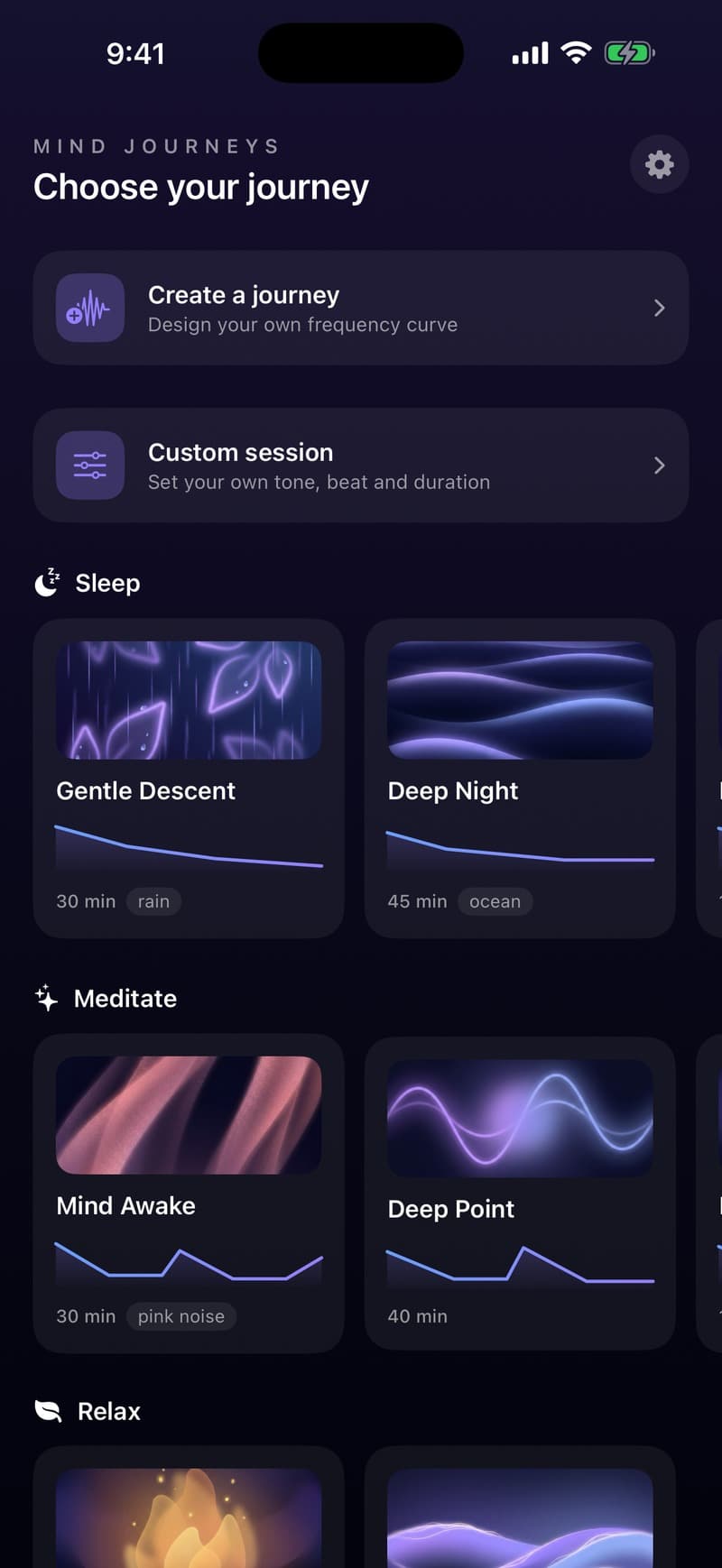
Fourteen of them across sleep, meditation, relaxation and focus. Every card shows its own curve, so you can see where it takes you before you press play.
02
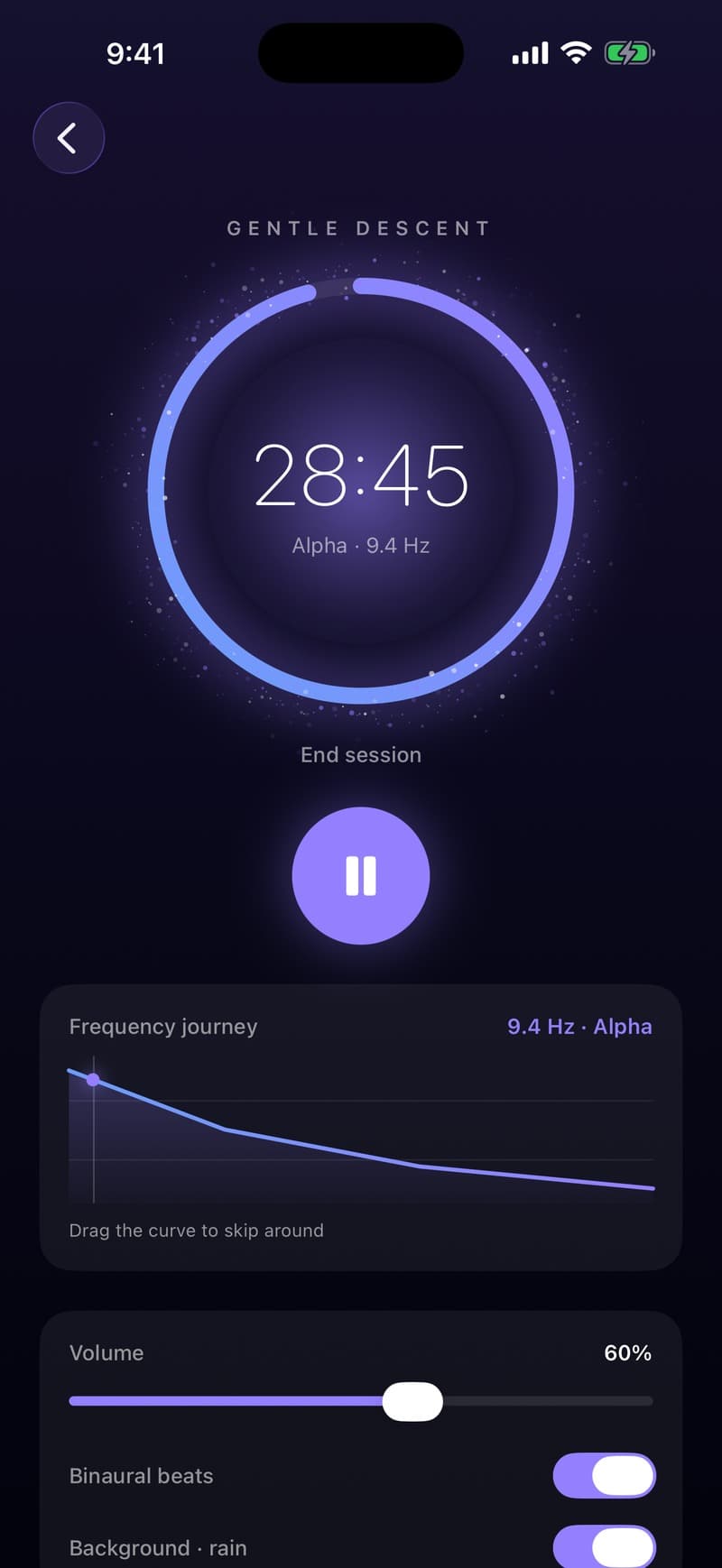
The current beat frequency and its band, live, with the whole curve underneath. Drag along it to skip ahead or drop back.
03
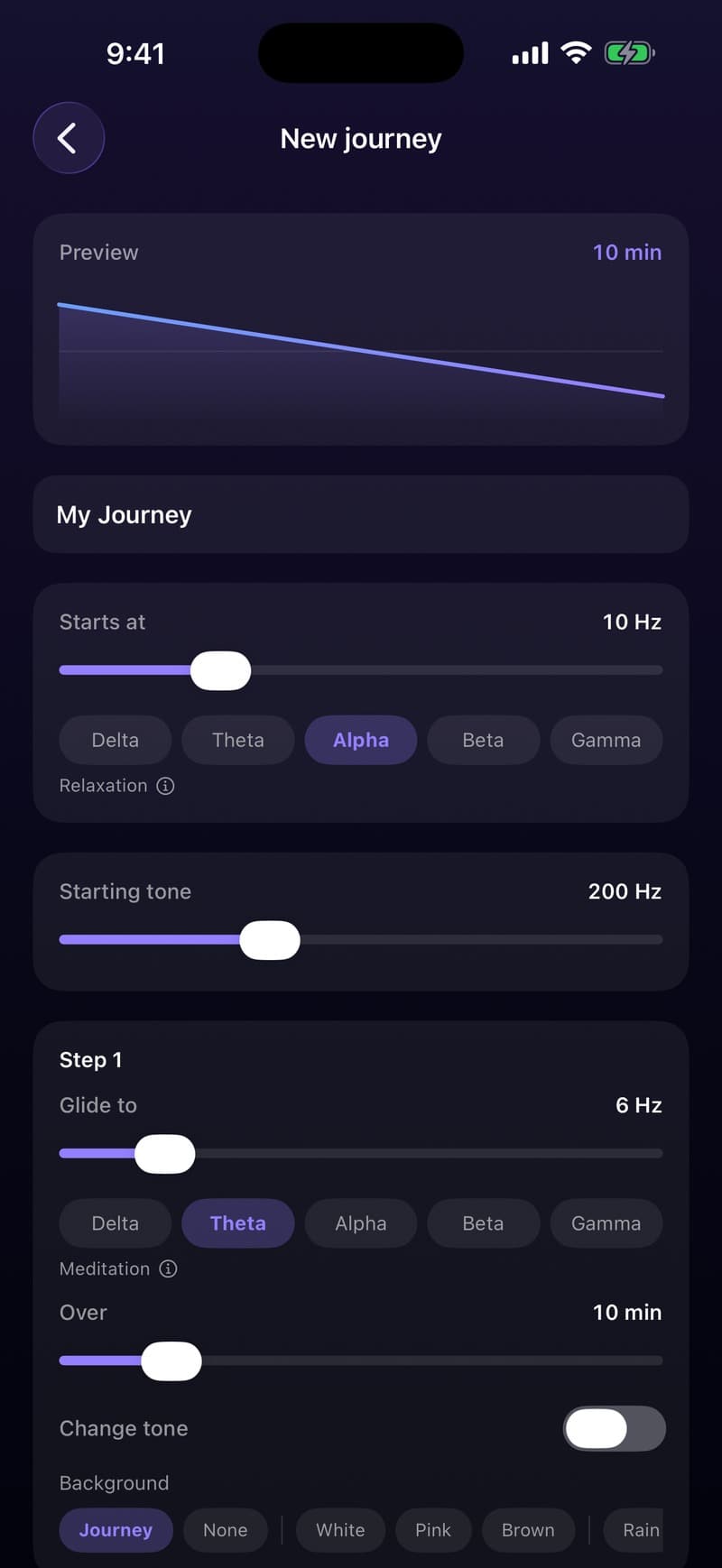
Set where you start, then chain steps. Each one glides to its own frequency over its own length, with its own background.
What's different
The distinction is the whole app. Everything below is a statement about the software — what it lets you build and play — and not a claim about what any of it does to you.
A fixed recording you press play on.
A curve you author, step by step, and can edit after you've heard it.
One frequency for the whole track.
A tone that glides continuously between steps, delta through gamma.
One ambience baked into the file.
Sixteen beds, assignable per step, or silence where you want the tone alone.
The idea
A journey is an ordered list of steps. Each step names a frequency to reach and how long to take getting there, and the tone slides continuously between them — so a single session can cross three or four brainwave bands instead of sitting on one number.
Delta
0.5–4 Hz
The slowest rhythm, dominant in dreamless deep sleep. The floor a night-time journey settles onto.
Theta
4–8 Hz
The drowsy edge between waking and sleep. Deep meditation and drifting, image-rich states tend to live here.
Alpha
8–13 Hz
The relaxed idle. Awake and unhurried, thinking loosened but not gone. The bridge between focus and drift.
Beta
13–30 Hz
Ordinary waking attention — analysing, deciding, holding a task in mind. Where most of the day is spent.
Gamma
30–40 Hz
The fastest rhythm, associated with moments when attention snaps together and everything feels sharply bound.
Band boundaries are naming conventions and differ between sources; these are the ranges the app itself uses.
Journey Builder
The builder is the same model as the curve above, with sliders. Add a step, say where it should land and how long it has, and the preview redraws as you go.
Underneath the tone
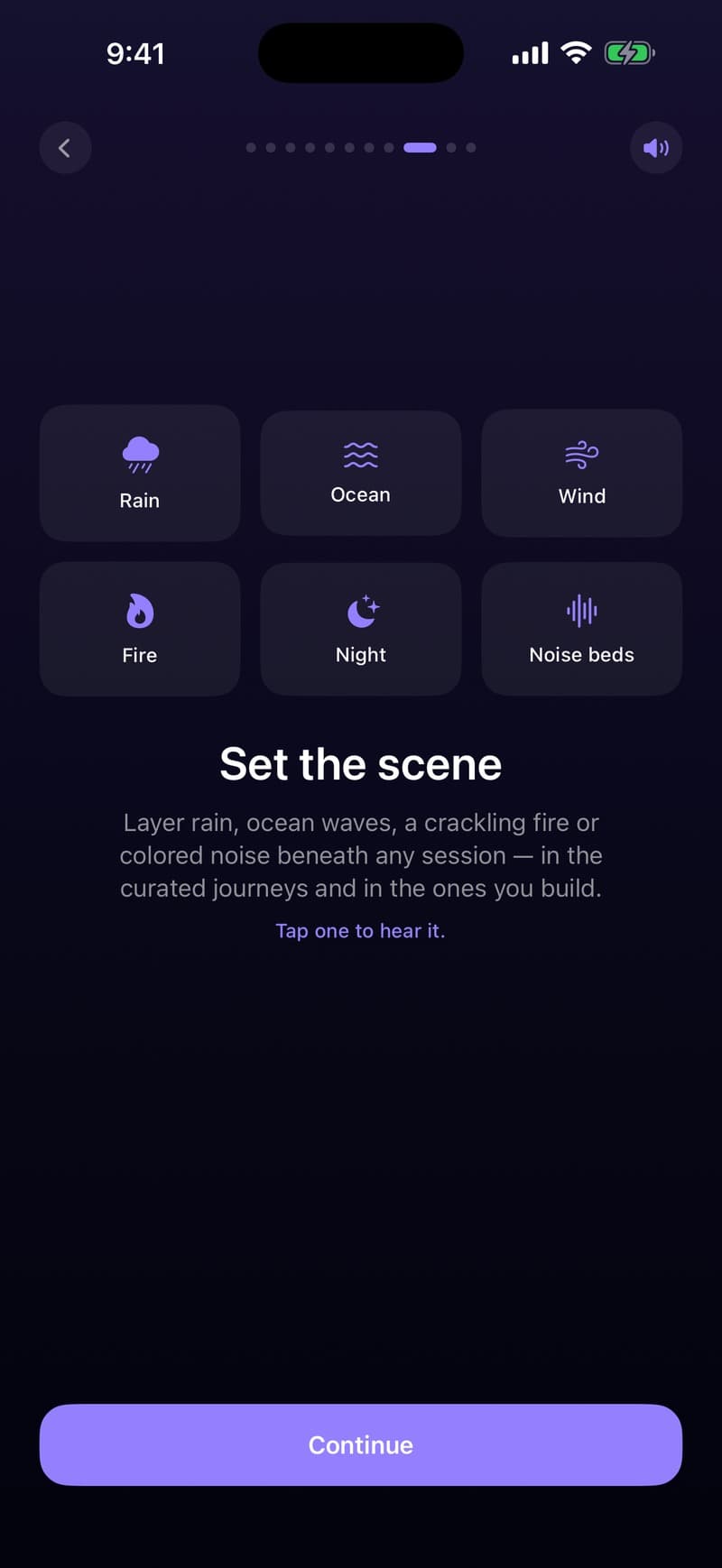
Natural scenes, the three noise colours, and a set of tonal beds — assignable per step, so one journey can open over rain and end on nothing but the tone.
Lock the phone, put it face down, or switch to another app — the journey keeps going, with its own controls on the lock screen.
Let a journey sit underneath whatever else is playing, so a tone can run beneath a podcast, a playlist or a guided meditation from another app.
Open over rain, move to nothing but the tone, finish on pink noise. Every step carries its own background, or inherits the journey's.
Drag along the frequency curve in the player to skip ahead or drop back. The tone follows to wherever you land.
The library
Play one as it is, or open it in the builder and make it yours.
The plain version
Worth knowing before you download, because it decides whether the app can work for you at all.
Each ear gets a pure tone of slightly different frequency. The beat you perceive is the difference between them — 200 Hz in one ear and 206 Hz in the other is heard as a 6 Hz beat.
The beat is produced by the auditory system rather than being present in the air. On a speaker the two tones mix before they reach your ears and the effect disappears. Any wired or wireless headphones will do.
Delta, theta, alpha, beta and gamma are naming conventions for ranges of EEG activity, and their boundaries differ between sources. That a band tends to dominate in a given ordinary state is a correlation in the EEG, not evidence that playing a beat at that frequency produces the state.
A 2019 meta-analysis by Garcia-Argibay and colleagues reported small-to-moderate associations between binaural-beat listening and self-reported anxiety, some memory and attention measures, and pain perception — while noting wide variation in protocol, frequency and exposure between the studies it pooled. A 2023 systematic review by Ingendoh and colleagues looked specifically at whether brain oscillations follow the beat, and found the evidence inconsistent: that inconsistency is the finding, not a footnote to it. Neither supports treating any of this as a therapy.
Try it in the browser
Pick a band, set the two tones, and see exactly what each ear receives. Live playback only — the app is where a whole journey happens.
Stereo headphones required. Each ear has to receive its own tone. Through a speaker the two mix in the air before they reach you and the binaural beat is gone. Start with the volume low — the beat does not get stronger as you turn it up.
The difference between the two ears. This is the sway you hear, and the number the bands are named for.
The pitch itself, sitting halfway between the two ears. The beat rides on it.
Left ear
197Hz
200 − 6 ÷ 2
beat
6Hz
difference
Right ear
203Hz
200 + 6 ÷ 2
Plain explanations of binaural beats and the brainwave bands, with the research reported as it stands rather than as anyone would like it.
14 journeys, 16 sound beds, and a builder for when none of them is quite the shape you want.
iPhone · iOS 17 and laterA tone generator with a good curve editor and a solid ambience library. It plays two slightly different frequencies, one per ear, so you need headphones. People use it for meditation, lucid dreaming practice, focus work and getting to sleep.
It makes no claims about what brainwave entrainment will do for you, and it is not a medical device or a treatment for any condition. Listen at a comfortable volume, never while driving, and if you have epilepsy or a seizure disorder, speak to a doctor before using entrainment audio.